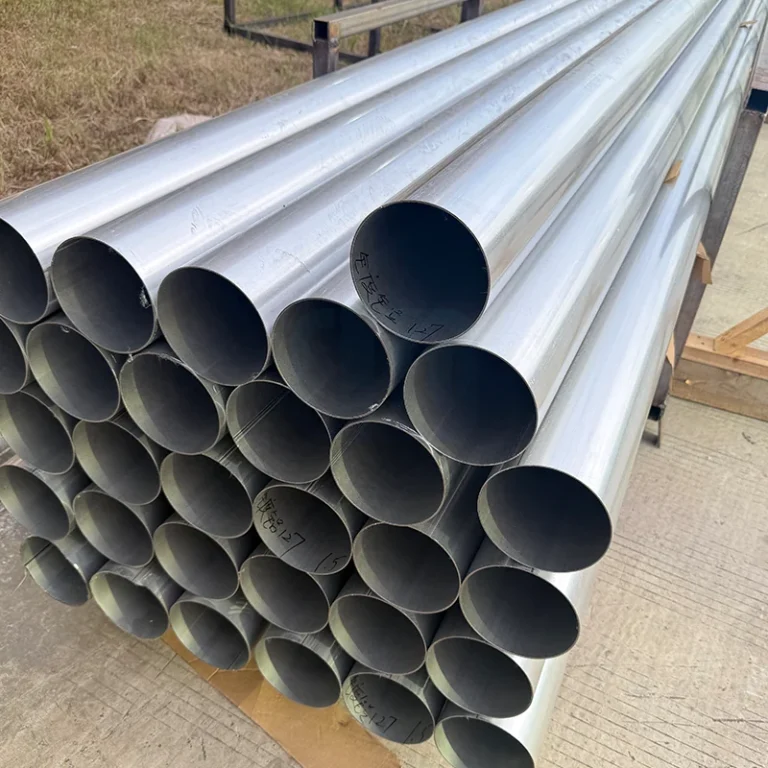
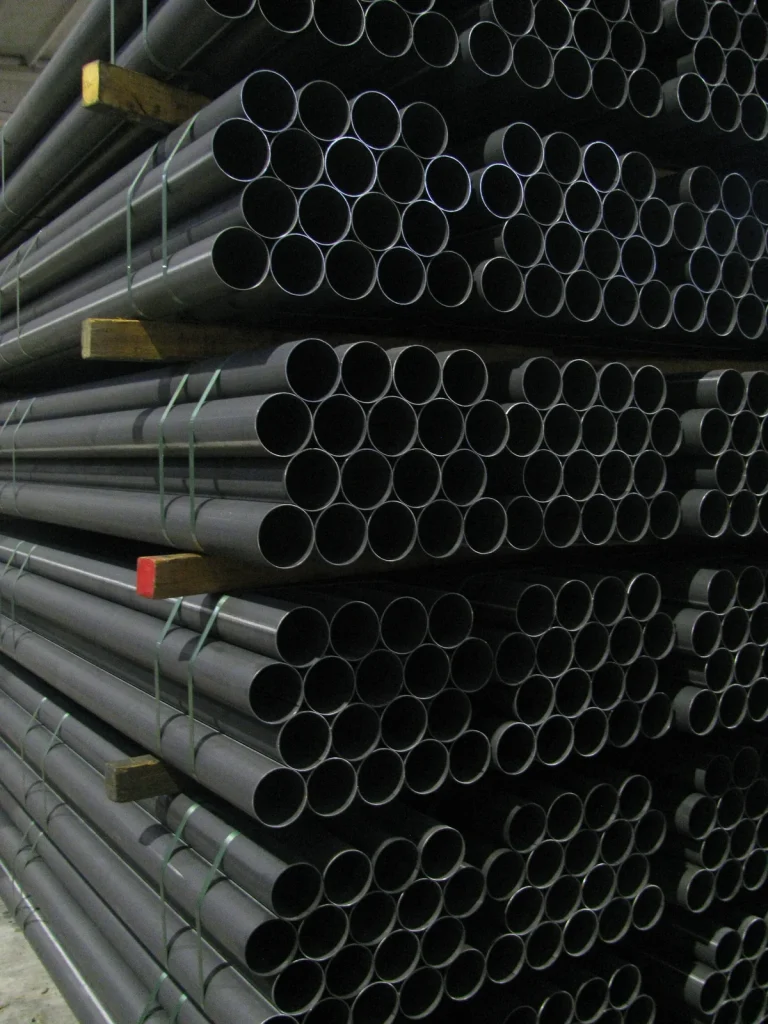
Aluminized Heat-Treated Tube
Heat-treated black aluminized tubes designed for gas-fired infrared heating systems, ovens, and industrial furnaces.
Explore Specification →Aluminized mild steel tubes with an aluminum-silicon coating for automotive exhaust and industrial thermal applications. Available in straight lengths, mandrel bends, and custom profiles, with outside diameters of 10–254 mm and wall thicknesses of 0.6–3.0 mm.
Aluminized mild steel tubes with an aluminum-silicon coating for automotive exhaust and industrial thermal applications. Available in straight lengths, mandrel bends, and custom profiles, with outside diameters of 10–254 mm and wall thicknesses of 0.6–3.0 mm.
Dumai Tube manufactures Aluminised Coated Mild Steel (ACMS) welded tubes, utilising cold-rolled low-carbon steel substrates (DX51D, DX53D, DX54D, DX56D) with a Type 1 hot-dip Al-Si coating (~90% Al / 10% Si). Production is carried out in accordance with EN 10346 and ASTM A463/A463M Type 1, with available dimensions ranging from an outer diameter (OD) of 10.0 mm to 254.0 mm and wall thicknesses from 0.6 mm to 3.0 mm, using ERW, high-frequency (HF) induction, or laser welding processes.
These tubes are primarily specified for automotive exhaust systems and industrial thermal applications, where cost efficiency and heat resistance are the governing requirements. The ACMS grade is typically applied to mufflers, intermediate pipes, tailpipes, and heat exchanger tubing. The heat resistance boundary depends on the substrate grade and service conditions; confirm the required grade and temperature range against the project specification.
The Al-Si coating forms a self-healing Al₂O₃ passivation layer that acts as a physical barrier against oxidation and chemical attack. In chloride-containing environments, the aluminium-rich outer layer also provides sacrificial anodic protection to the underlying steel substrate at coating defects. This dual protection mechanism delivers effective resistance to acidic exhaust condensate, road-salt pitting, and high-temperature oxidation.
All tubes are provided with EN 10204 Type 3.1 Mill Test Certificates (MTC) and can be fabricated into straight lengths, mandrel bends (1D to 3D radius), and special shapes. The DX53D+AS substrate offers a typical yield strength of 140–260 MPa and elongation of ≥30%, while the DX56D+AS offers a lower yield strength (120–180 MPa) and higher elongation (≥39%), ensuring stable coating adhesion even during complex cold forming and tight-radius bending.
All ACMS grades utilize a Type 1 hot-dip Al-Si coating (90% Al / 10% Si),metallurgically bonded to cold-rolled low-carbon steel according to EN 10346 / ASTM A463M Type 1. The coating maintains heat resistance up to 800°C (depending on steel grade) without flaking or surface changes. Upon contact with oxygen, a self-healing Al₂O₃ passivation layer forms immediately on the surface, providing a physical barrier against chemical attack (pH 4.5–8.5) and renewing itself at scratch sites. In chloride-containing environments, the aluminium-rich layer provides sacrificial anodic protection at coating defects.
DX53D+AS — Standard Deep-Drawing
EN 10346. Yield strength 140–260 MPa, tensile strength 270–380 MPa, elongation ≥30% (A80). The bendability of the hot-dip Al-Si coated steel is equivalent to that of classic galvanised steel, and no flaking is observed regardless of T-bend radius. Specified for mufflers, intermediate pipes, and tailpipes with standard bend radii (≥1.5D).
DX54D+AS — Advanced Deep-Drawing
EN 10346. Yield strength 120–220 MPa, tensile strength 260–350 MPa, elongation ≥34% (A80, +AS coating). The lower yield strength and higher ductility reduce bending strain on the coating, enabling more complex mandrel bends (1.5D–2.0D) and moderate deep-drawn profiles. High-emissivity variants are also available for heat-shield applications. Specified for complex exhaust pipes, heat shields, and custom bent components.
DX56D+AS — Extra Deep-Drawing
EN 10346. Yield strength 120–180 MPa, tensile strength 260–350 MPa, elongation ≥39% (A80, +AS coating). Exceptional ductility accommodates tight-radius mandrel bending (≤1.5D) and deep-drawn shell geometries with reduced risk of coating delamination. Specified for extreme exhaust geometries, deep-drawn converter shells, and highly customized structural tubes.
Temperature Boundary & Coating Mass Selection
The Type 1 Al-Si coating withstands temperatures up to 800°C (depending on steel grade) without flaking. For standard deep-drawing grades such as DX53D+AS and DX54D+AS, continuous service up to 650°C is verified. Higher-grade substrates (e.g., DX55D+AS) are specifically developed to guarantee coating integrity up to 800°C and are recommended for parts upstream of the front silencer.
Coating mass: AS80 (80 g/m²) and AS120 (120 g/m²). AS120 offers ~50% thicker coating, extending sacrificial protection in aggressive environments (heavy road-salt, severe thermal cycling). For ultra-deep drawing where maximum coating ductility is required, lower coating weights (AS50/AS60) are available.
Formability & Bending (Substrate Grade): The DX grade dictates the achievable bend radius and forming complexity. DX53D+AS (YS 140–260 MPa, EL ≥30%) is specified for standard bend radii (≥1.5D) in mufflers and intermediate pipes. DX54D+AS (YS 120–220 MPa, EL ≥34%) supports more complex mandrel bends (1.5D–2.0D) and heat shields. DX56D+AS (YS 120–180 MPa, EL ≥39%) provides the highest ductility, enabling tight-radius mandrel bending (≤1.5D) and deep-drawn converter shells.
Corrosion Protection (Coating Mass): AS80 provides standard protection for typical exhaust environments. For severe conditions—heavy road-salt, severe thermal cycling, or front muffler positions—AS120 is recommended, as its ~50% thicker coating extends sacrificial anodic protection and self-healing Al₂O₃ barrier life.
Thermal Boundary: All standard DX deep-drawing grades are rated for continuous service up to 650°C without coating flaking. For applications approaching the peak intermittent limit of 800°C, higher-grade substrates such as DX55D+AS are specifically developed to guarantee long-term coating integrity and are recommended for parts upstream of the front silencer.
| Parameter | Specifications |
|---|---|
| Material Grades | ACMS (Aluminized Coated Mild Steel): | DX51D+AS, DX53D+AS, DX54D+AS, DX56D+AS |
| Outer Diameter (OD) | 10.0 mm – 254.0 mm |
| Wall Thickness (WT) | 0.6mm – 3.0 mm |
| Length | Cut-to-size |
| Manufacturing Process | ERW, HF, Laser Welding |
| Standards | EN 10346, ASTM A463M Type 1, JIS G3314, or Customer Drawings |
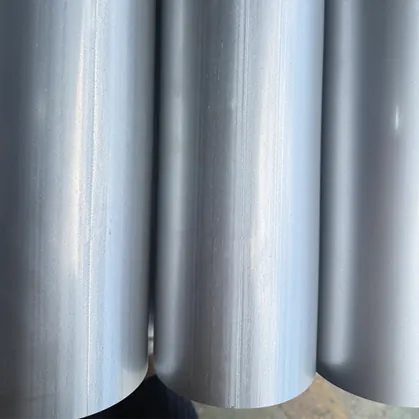
| Surface Finish | Raw Aluminized, Heat-treated Aluminized, Oiled (Customized) |
| MOQ | 3–5 tons (Negotiable) |
A. Straight Tubes
Process: ERW, HF Welding, Laser Welding
Size Range: OD 10.0–254.0 mm, WT 0.6–3.0 mm
Standard Length: 6 m (cut-to-length available )
Applications: Automotive exhaust systems, mufflers, tailpipes, heater tubes, industrial heat exchangers.
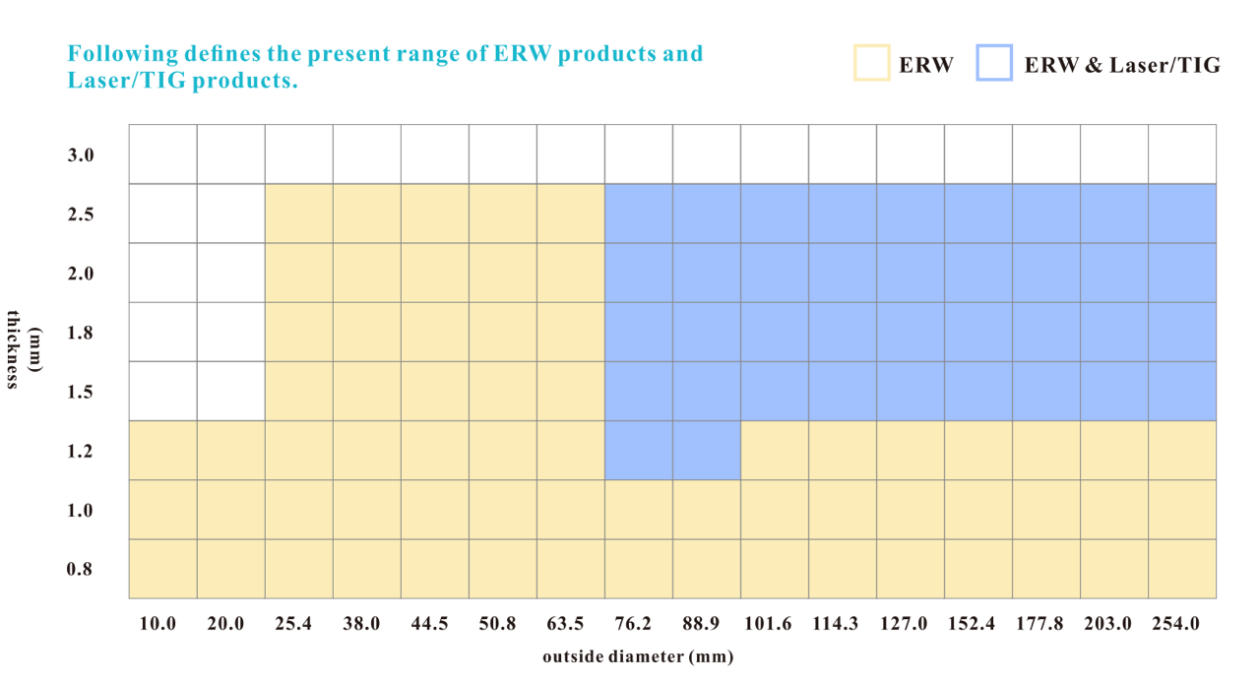
Our straight tube sizes are aligned with common European and global exhaust system practices. The table below reflects the most frequently requested dimensions, material pairings, and their typical positions within the exhaust line.
| OD | WT | Recommended Grade | Coating Rec. | Typical Position & Rationale |
|---|---|---|---|---|
| 32.0 mm | 1.2 | DX53D+AS | AS80 | Downpipe |
| 38.1 mm (1.5″) | 1.2 / 1.5 | DX53D+AS / DX54D+AS | AS80 / AS120 | Downpipe, intermediate |
| 44.5 mm (1.75″) | 1.2 / 1.5 | DX54D+AS | AS120 | Intermediate pipe |
| 50.8 mm (2.0″) | 1.2 / 1.5 | DX53D+AS / DX54D+AS | AS120 | Muffler connecting |
| 57.0 mm (2.25″) | 1.2 / 1.5 | DX54D+AS / DX56D+AS | AS120 | Main exhaust line |
| 63.5 mm (2.5″) | 1.5 | DX54D+AS | AS120 | Muffler shell |
| 76.2 mm (3.0″) | 1.5 | DX56D+AS | AS120 | Complex bent tailpipe |
| 101.6 mm (4.0″) | 1.5 | DX56D+AS | AS120 | Large tailpipe |
| 127.0 mm (5.0″) | 1.5 / 2.0 | DX54D+AS / DX56D+AS | AS120 | Large muffler shell |
B. Mandrel Bends
Bend Radius: 1D, 1.1D, 1.2D, 1.5D, 1.6D, 2D, 3D or customized.
(Engineering Note: DX53D/DX54D for 1.5D–3D standard bends; DX56D+AS is required for tight-radius 1D–1.5D bending to prevent coating delamination. )
Bend Angle: 15°, 30°, 45°, 60°, 90°, 180° or customized.
Tube Type: ERW welded, HF welded, Laser welded aluminized tube bends.
End Finish: Plain, expanded, reduced, slotted, beaded, or customized.
C. Special Shape Tubes
Available Profiles: Round, Oval, Semi-Oval, Elliptic, Square, Octagonal, Rectangular
Customization: Outer dimensions (A×B), wall thickness, steel grade, surface finish (Raw Aluminized, Heat-treated Aluminized, Oiled), length
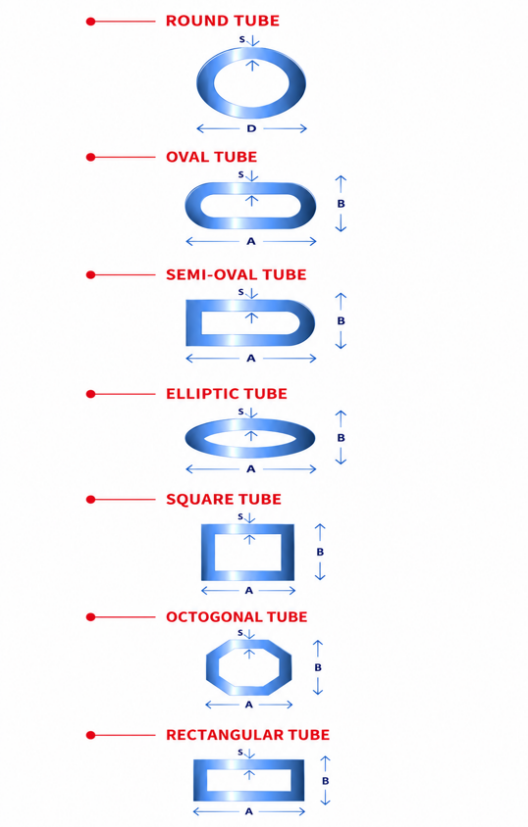
| Profile Type | Typical Size Range | Wall Thickness Range | Common Use |
|---|---|---|---|
| Round Tube | Customized according to OD requirement | 0.6 – 3.0 mm | Exhaust tubes, mufflers, tailpipes |
| Oval Tube | According to customer drawing | 0.6 – 3.0 mm | Exhaust parts, space-saving tube design |
| Semi-Oval Tube | According to customer drawing | 0.8 – 3.0 mm | Customized exhaust components |
| Elliptical Tube | According to customer drawing | 0.8 – 3.0 mm | Automotive and industrial tube assemblies |
| Square Tube | Customized | 0.8 – 3.0 mm | Special structural or heat-resistant applications |
| Rectangular Tube | Customized | 0.8 – 3.0 mm | Exhaust structures and fabricated parts |
Core Value: Cost-effective and lightweight replacement for 409 stainless steel in mid-temperature zones.
Cold-End & Mid-End Components (Continuous ≤ 650°C): Mufflers, resonators, intermediate pipes, and tailpipes. ACMS with AS120 coating effectively resists acidic exhaust condensate and road-salt corrosion.
Heater Tubes & Heat Shields: Applied in automotive heating systems and heat shields, leveraging the coating’s high thermal reflectivity and oxidation resistance.
Core Value: High-temperature oxidation resistance for industrial gas handling.
Industrial Exhaust Ducts & Silencers: For off-road equipment, generator sets, and factory ventilation systems requiring long-term outdoor atmospheric corrosion resistance.
Heating Equipment Components: Used in low-to-medium temperature industrial furnaces, boilers, and HVAC systems (operating up to 650°C).
Heat Exchanger Tubing: An economical choice for low-to-medium temperature industrial heat exchangers (e.g., automotive radiators, waste heat recovery).
Core Value: Excellent formability and atmospheric corrosion resistance.
Architectural & Construction: Roofing, culverts, and structural supports requiring long-term rust prevention.
Agricultural Equipment: Exhaust lines and structural frames for tractors and farm machinery.
Engineering Balance: ACMS achieves the optimal balance between durability and cost, making it the primary choice for mass-market passenger vehicle exhausts. Stainless steel (409 for standard, 304 for premium) is specified based on thermal, aesthetic, and lifecycle requirements.
| Comparison Metric | Aluminized Steel (ACMS) | Ferritic SS (e.g., 409) | Austenitic SS (e.g., 304) |
|---|---|---|---|
| Cost Advantage | Baseline (Lowest material cost). | 30%–40% higher than ACMS. | 60%–70% higher than ACMS. |
| Typical Service Life | 8–12 years (Depends on coating mass & salt exposure). | 10–15 years (Standard OEM lifecycle). | 15+ years (Matches vehicle lifecycle). |
| Corrosion Mechanism | Sacrificial anodic protection (Al-Si coating) + self-healing Al₂O₃ barrier. | Passive oxide layer (Cr₂O₃), but lower Cr (~11%) limits chloride resistance. | Robust passive layer (Cr₂O₃, 18-20% Cr). Virtually immune to road salt. |
| Target Segment | Mass-market Passenger Cars (Sedans, SUVs, Light Commercial Vehicles). | Standard OEM Exhausts (Hot/mid-end components). | Premium / Luxury Cars, Performance, Aftermarket. |
| Typical Position | Mid-pipes, mufflers, tailpipes (Cold to mid-temperature). | Front pipes, converter shells, intermediate pipes (High/mid temp). | Visible tailpipes, tips, high-end mufflers. |
Our manufacturing processes are carried out under an ISO 9001-certified quality management system, ensuring strict control from raw coil to finished tube.
To verify weld seam integrity, non-destructive testing—including 100% Eddy Current Testing (ECT)—is performed. Hydrostatic testing is available based on customer specifications and project requirements.
Each shipment is accompanied by an EN 10204 Type 3.1 Mill Test Certificate (MTC), detailing substrate grade, coating mass (e.g., AS80/AS120), mechanical properties, and test results for full batch traceability in accordance with EN 10346 / ASTM A463M standards.
To ensure tubes arrive free from mechanical damage, deformation, and surface corrosion (especially white rust) after long-haul transit, we use export-ready packaging tailored to tube dimensions and coating types:
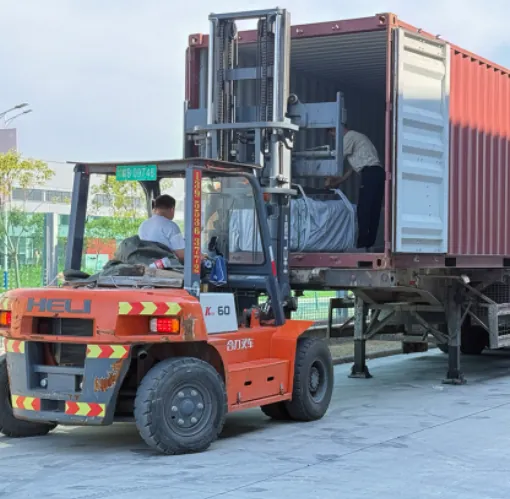
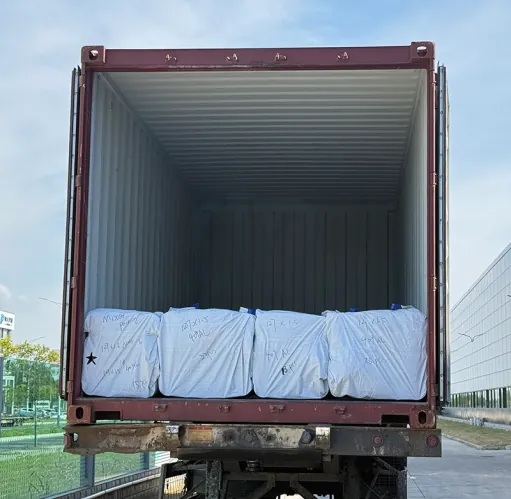
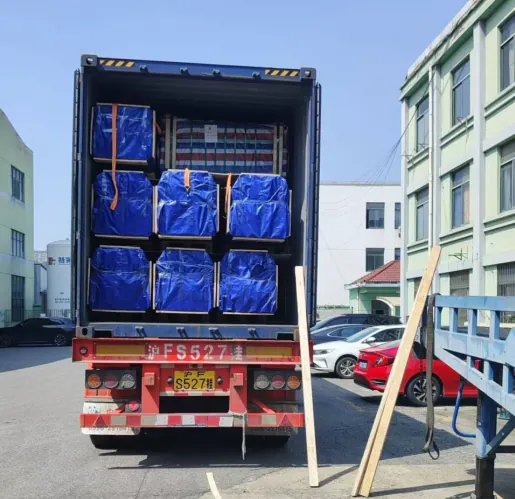
Plastic end caps are standard to protect tube ends; waterproof sealing is available upon request.
Tubes are tightly bundled with steel or high-strength plastic straps. VCI (Volatile Corrosion Inhibitor) film or anti-rust paper is highly recommended and applied to prevent moisture-induced white rust on the Al-Si coating.
Seaworthy wooden cases (ISPM 15 compliant) or reinforced pallets are available for thin-wall, special-shape, or high-value orders.
ACMS tubes are strictly packed separately from stainless steel tubes to avoid cross-contamination (iron contact).
Packaging specifications can be fully customized to meet your specific handling and storage requirements.
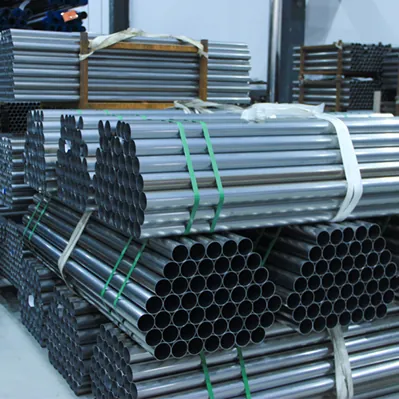
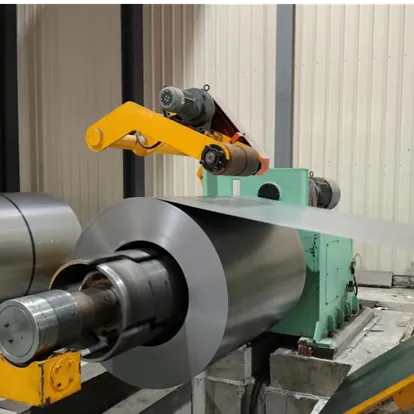
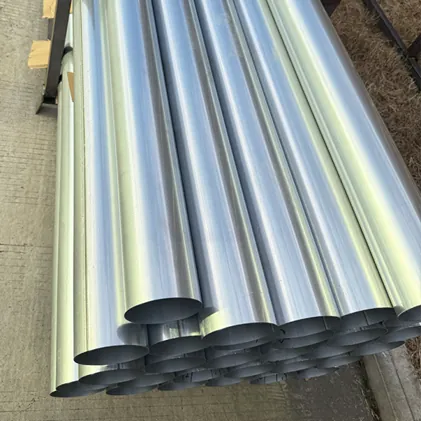
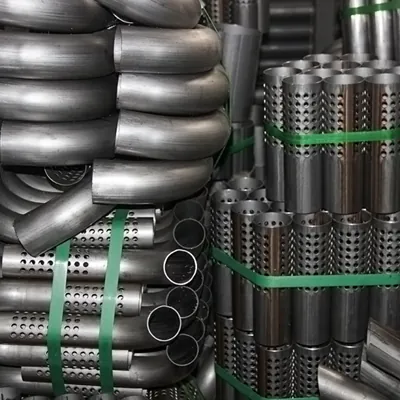
Operational Footprint: Two manufacturing bases in China with a combined annual tube capacity of 40,000 tons (2025 actual output: 29,000 tons).
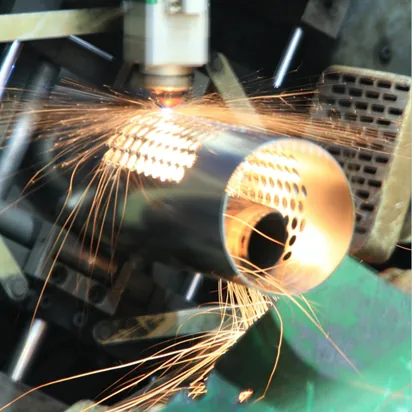
Production Lines: Equipped with fully automated ERW/HF/Laser welding lines and in-line weld annealing & laser gauging systems to ensure dimensional consistency and weld ductility at scale.
Facility Scale: 20,000 m² covered production area, integrating slitting, forming, welding, and finishing.
Dedicated Technical Team: Backed by 5 in-house engineers and metallurgists with an average of 10 years of experience in carbon steel and stainless steel tube forming.
Forming Capability: Proven production capability for tight-radius mandrel bending (1D–3D) with wall thinning controlled at ≤10–15%, ensuring Al-Si coating integrity without delamination.
Material Versatility: Certified to process DX51D, DX53D, DX54D, DX56D with AS80/AS120 coatings, handling custom grades and special shapes within OD 10.0–254.0 mm.
System Certification: Operating under a single ISO 9001-certified Quality Management System.
Non-Destructive Testing (NDT): Standard 100% Eddy Current Testing (ECT) for weld seam integrity, with hydrostatic testing available upon specification.
Traceability: Every shipment is accompanied by an EN 10204 Type 3.1 MTC, traceable directly to the steel heat number and coating batch record.
Client Portfolio: A trusted supplier to global automotive exhaust manufacturers, commercial vehicle OEMs, and industrial heat exchanger fabricators.
Compliance: Strict adherence to international material standards (EN 10346, ASTM A463M Type 1, JIS G3314) and dimensional tolerances, eliminating integration risks in your supply chain.
Methods: Precision saw cutting or laser cutting.
Length Tolerance: Standard ±0.5 mm (Tighter tolerances available upon request).
End Condition: Square cut, deburred, and free of deformation.
Capability: Cold mandrel bending for tight radii.
Radius Range: 1D to 3D (Higher-grade substrates like DX56D+AS recommended for ≤1.5D tight radii to prevent coating cracking).
Tolerances: Bend angle ±1°; Wall thinning ≤10–15% at the outer radius; Ovality ≤7%.
Tooling: Advanced core rods and wiper dies utilized to prevent coating damage and wrinkling.
Swaging: Reduces tube diameter at the ends for hose connections.
Bell-mouth / Expanding: Ideal for slip-fit joints and exhaust mating interfaces.
Slotting: Precision milled slots for clamp mounting.
Processes: High-Frequency (HF) induction welding, Laser welding, ERW.
ID/OD Scarfing: Available. Internal and external weld beads are removed and smoothly finished to ensure unobstructed flow and prevent localized coating degradation.
Weld Seam Integrity: Verified by 100% Eddy Current Testing (ECT).
Standard Finish: Raw Aluminized, Heat-treated Aluminized.
Protective Coating: Light oiling applied to prevent white rust during ocean transit (can be easily removed by the customer before welding/painting).
Contact Dumai Tube to discuss materials, drawings, and your quotation requirements.