Semi Finished Exhaust System Components
Technical supply guide | Customer drawing manufacture | Stainless and aluminized steel
Product Details
For OEM, Tier 1 and aftermarket exhaust manufacturers. This guide defines a practical specification and quotation framework for tube blanks and formed components supplied for further assembly. Exact capacities, acceptance limits and customs classification are established per drawing, production trial and destination market.
Product scope
A semi-finished exhaust component is a tube-based item produced to an agreed drawing for subsequent use in an exhaust assembly. The deliverable may be a straight cut blank, a perforated blank, an expanded or reduced end, or a bent section. “Semi-finished” describes manufacturing stage; it does not establish a customs classification.
| Supply configuration | Typical operations | Information to define |
|---|---|---|
| Cut tube blank | Welded tube; cut to fixed length; deburr | OD × wall × length; cut tolerance; cut squareness |
| End-perforated tube blank | Cut to length; hole(s) near one or both ends | Hole Ø/count; pitch; axial offset; angular orientation |
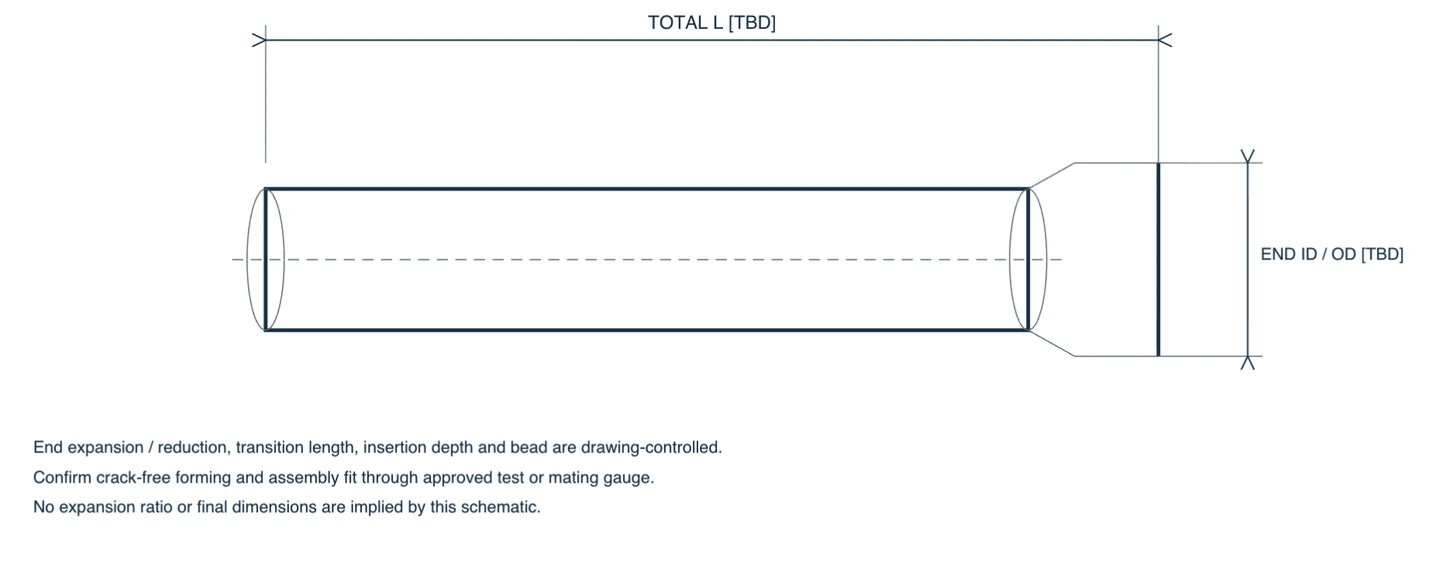
| End-formed exhaust tube | Cut; bead, flare, expand, reduce or swage | Form geometry; gauge datum; mating part |
| Bent exhaust section | Cut, bend and optional perforation | Centerline radius; bend angle; datum; profile tolerance |
Materials and application choices
| Material family | Indicative grades | Engineering consideration |
|---|---|---|
| Ferritic stainless | AISI 409 / 409L | Common exhaust-grade family; confirm corrosion and thermal design needs. |
| Ferritic stainless | AISI 430 / 439 / 441 | Potential higher oxidation/corrosion requirements; grade selection by OEM drawing. |
| Austenitic stainless | AISI 304 / 316 | For specified corrosion, process or elevated-service requirements. |
| Aluminized steel | DX51D–DX56D + AS80 / AS120 / AS150 | Al–Si coating designation and coating mass per specified standard; verify forming and weld condition. |
Material designation alone is insufficient. Confirm governing standard and edition (e.g., EN 10346 for specified coated strip), steel certificate, coating requirements, weld process, thickness tolerance and any customer-specific bend or flare qualification.
Drawing-controlled specifications and manufacturing route
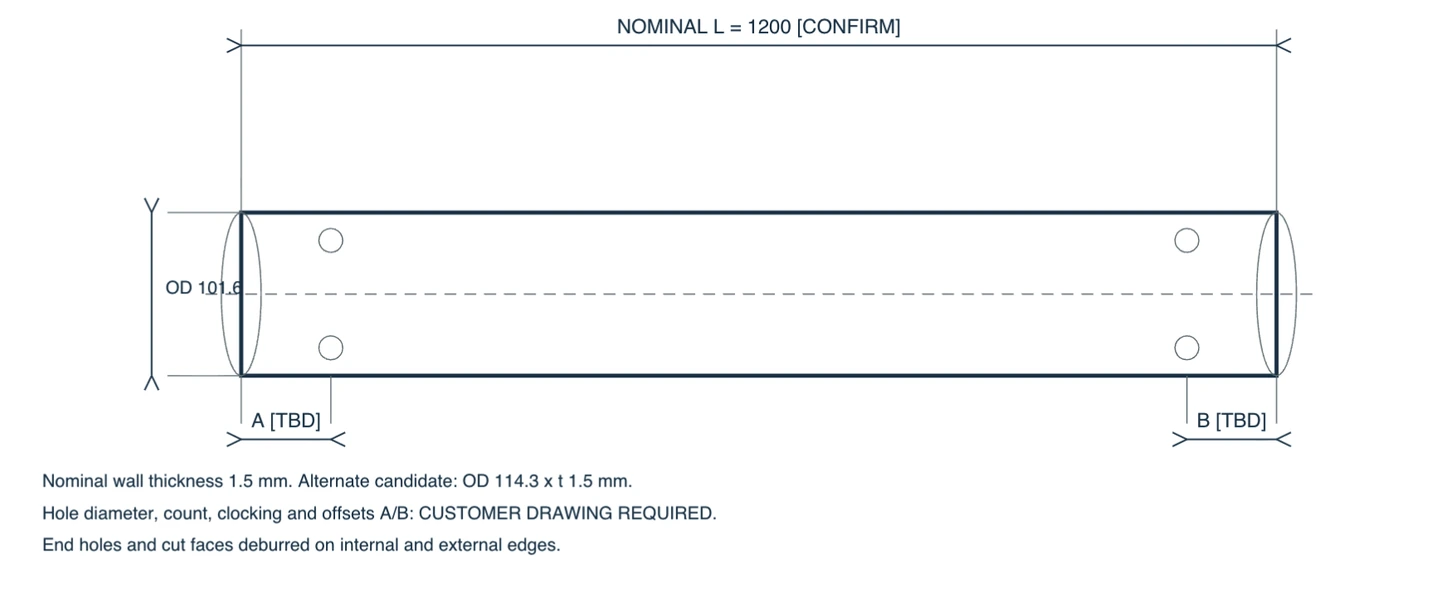
Drawing requirements for an end-perforated blank
Reproduction of a customer-approved drawing: AISI 304 welded tube, nominal Ø101.6 × 1.5 × 1,200 mm, with holes positioned near the ends. Another possible size is Ø114.3 × 1.5 × approximately 1,200 mm. These are reference dimensions from prior commercial discussions; all hole geometry, exact length and tolerances must come from the customer drawing.
Source specification note: The supplied guide lists a 1,200 mm example length in the prose and marks 1,200 mm “confirm” in the first drawing, while the parameter table lists approximately 1,014 mm. Confirm the controlled customer drawing before quotation or production.
| Drawing field | Required customer instruction |
|---|---|
| Part identification | Part no., revision, drawing date, assembly name, revision approval |
| Tube geometry | OD, nominal/actual wall, length, tolerances, ovality, straightness |
| End holes | Diameter and tolerance, hole count, distance from cut face, clocking, both-end symmetry |
| Cut edges | Squareness and edge break; explicit maximum burr or “no detectable burr” method |
| Surface | Oil-free/cleanliness criterion, allowed discoloration, scratch limits, passivation if required |
| Traceability | Material heat, coil/batch ID, MTC, pack label and part number |
| Functional tests | Required flaring, flattening, bending or leak criteria; frequency and test standard |
Typical process flow
Incoming coil verification → slitting → HF/laser/TIG tube forming and welding (as applicable) → inline weld inspection → cut-to-length → drilling/punching near ends → internal and external deburring → cleaning/drying → final dimensional and visual inspection → protected packaging → dispatch.
When drilling follows cutting, fixture the tube using a defined axial and angular datum. Confirm hole-to-end distance, location relative to seam where relevant, and that piercing does not leave an internal lip. Inspect both cut ends and holes after finishing.
Specification checklist for a semi-finished exhaust component
| Parameter | Example specification |
|---|---|
| Material | AISI 304 stainless steel |
| Construction | Welded circular tube |
| Outside diameter | Ø101.6 mm or Ø114.3 mm |
| Nominal wall thickness | 1.5 mm |
| Cut length | Approximately 1,014 mm |
| Perforations | Near both ends; geometry per customer drawing |
| Surface condition | Oil-free to agreed cleanliness criterion |
| Edge condition | Deburred to agreed acceptance criterion |
| Technical documentation | Customer-approved drawing and part revision |
| Quality inspection | Dimensional, visual and weld-quality verification |
| Intended application | Automotive exhaust system component |
Example dimensions are illustrative. Hole dimensions, length and all tolerances require customer approval before production.
Why Choose Dumai Tube
Trade and Logistics Advantages
Reduced downstream processing. Cutting, perforation and forming at the source can reduce manufacturing steps after delivery.
Dimensional consistency. Production to approved drawings supports repeatable assembly fit.
Flexible material selection. Ferritic stainless, austenitic stainless and aluminized steel options suit different applications and cost requirements.
Coordinated sourcing. Customers may combine tube manufacture and selected secondary processes through one supplier.
Documented export supply. Material traceability and inspection documentation support importer and broker review.
International delivery. Packaging and transport arrangements are tailored to the required destination and handling conditions.
Dumai Tube combines precision welded tubing with customer-specific cutting, perforation, forming and finishing operations to support exhaust manufacturers requiring components prepared for their subsequent assembly processes.
OEM Support
Customer approval before series production
- Confirm a controlled PDF/DWG/DXF drawing and an agreed revision; flag any undimensioned feature.
- Provide first-article samples with dimension report and photographs; use a signed sample approval before volume supply.
- Agree inspection plan and acceptance limits before production, including whether destructive test specimens are required.
Customs Classification and International Trade Documentation
Dumai Tube supplies precision-manufactured steel tubing and semi-finished exhaust system components for automotive and industrial applications. Through customer-specific operations including cut-to-length processing, perforation, end forming and bending, we can deliver components tailored to the technical requirements of exhaust system manufacturers.
Customers can source both standard welded tubing and application-specific components manufactured according to approved engineering drawings.
HS Classification of Steel Tubes and Exhaust Components
International customs classification distinguishes between general-purpose steel tubing and components manufactured for specific applications. Depending on the material, manufacturing process and the characteristics of the goods as imported, the following HS headings may be relevant.
| HS code | Product description | Typical application |
|---|---|---|
| 7306.40 | Welded circular stainless steel tubes | Welded tubing in AISI 304, 409L, 439 and 441 when classified as tubes. |
| 7306.30 | Welded circular iron or non-alloy steel tubes | Certain aluminized steel and other welded non-alloy steel tubing. |
| 7304 | Seamless steel tubes | Seamless tubing for industrial applications. |
| 8708.92 | Motor-vehicle exhaust pipes, silencers and their parts | Qualifying identifiable automotive exhaust components, including certain unfinished parts. |
HS 8708.92 is particularly relevant for automotive exhaust pipes, silencers and their parts. Subject to their objective characteristics and the applicable tariff rules, semi-finished components made specifically for automotive exhaust systems may fall within that heading. Final classification must be checked for the actual imported product and destination market.
Customer-Specific Manufacturing for Exhaust Applications
Dumai Tube offers selected processing operations to manufacture components according to customer drawings and assembly requirements:
- Precision cut-to-length – specified cut length, tolerance and end squareness.
- End perforation – customer-defined holes near one or both ends, including hole diameter and positioning.
- End forming – expansion, reduction, flaring, swaging or other joining geometry where agreed.
- Tube bending – defined bend angle, centerline radius and leg dimensions.
- Deburring – removal of sharp edges and loose metal particles at cut ends and holes.
- Oil-free finishing – cleaning to an agreed surface cleanliness requirement.
- Quality inspection – dimension checks, weld-quality controls and applicable mechanical tests.
These operations help customers receive tube components prepared for subsequent assembly and may reduce downstream machining, handling and supplier coordination.
Customs Classification Support
Dumai Tube can provide technical records supporting the importer and customs representative in evaluating the applicable classification and completing clearance:
- Commercial invoice – accurate material, dimensions, manufacturing operations, part identification and origin.
- Packing list – quantities, net/gross weights, packing units and package dimensions.
- Engineering drawings – controlled customer drawing, part number and revision.
- Material test certificate – specified material properties and traceability.
- Product photographs – clear views of component geometry and processing features.
- Inspection records – dimensions, edge finish and agreed quality tests.
- Manufacturing description – process information where requested for classification review.
For repeated EU imports where classification requires certainty, the importer may seek a Binding Tariff Information (BTI) decision from an EU customs authority.
Packaging & Shipping
Quality, finish and packaging
Proposed product quality language
- Cut to customer-approved length and dimensional tolerance, with clean perpendicular ends.
- Free from sharp burrs at internal/external cut edges and perforations. “Burr-free” must be linked to a defined inspection or edge-break criterion.
- Oil-free upon delivery when specified: clean off cutting oils and loose contaminants; define whether this means visually clean or a measurable residue limit.
- No unacceptable scratches, dents, crushing, embedded chips or corrosive staining. Cosmetic acceptance standard and handling marks to be agreed.
- Weld seam integrity and formability verified per agreed inspection/test plan; MTC issued to the specified EN 10204 type if requested.
Recommended quality records
| Document / test | Purpose / release condition |
|---|---|
| Material Test Certificate | Heat/coil chemistry and mechanical data; EN 10204 3.1 if specified and available. |
| Dimensional inspection | OD, thickness, length, hole size/position, edge condition. |
| Flaring / flattening / bending | Only where applicable to part and specified method; record outcome and sample basis. |
| Weld NDT / visual | Eddy-current/UT or other method if offered and required; record acceptance criterion. |
| First Article Inspection | Drawing revision cross-check and initial sample dimensional evidence. |
| Packaging list / batch label | Part no., quantity, net/gross weight, heat/lot and carton/bundle count. |
Packaging and shipment
Protect all ends and perforations from abrasion. Bundle or compartmentalize parts with polymer film, interleaves, end caps or dividers where required. Add moisture protection suitable for the route; specify whether oil-free parts must avoid oily paper. Use crates/pallets only as agreed. Record count, gross/net weight, bundle dimensions and handling orientation. Container loading must respect actual payload limits and securement design.
Commercial quotation data
Quote by part number and revision, grade/standard, OD × wall × cut length, total pieces and estimated net mass; state tooling, hole-making, deburring, cleaning, QA, packaging, lead time, Incoterms 2020 delivery point and payment terms as separate line items or explicit inclusions.
Need Custom Grades, Radii, or Shapes?
Contact Dumai Tube to discuss materials, drawings, and your quotation requirements.