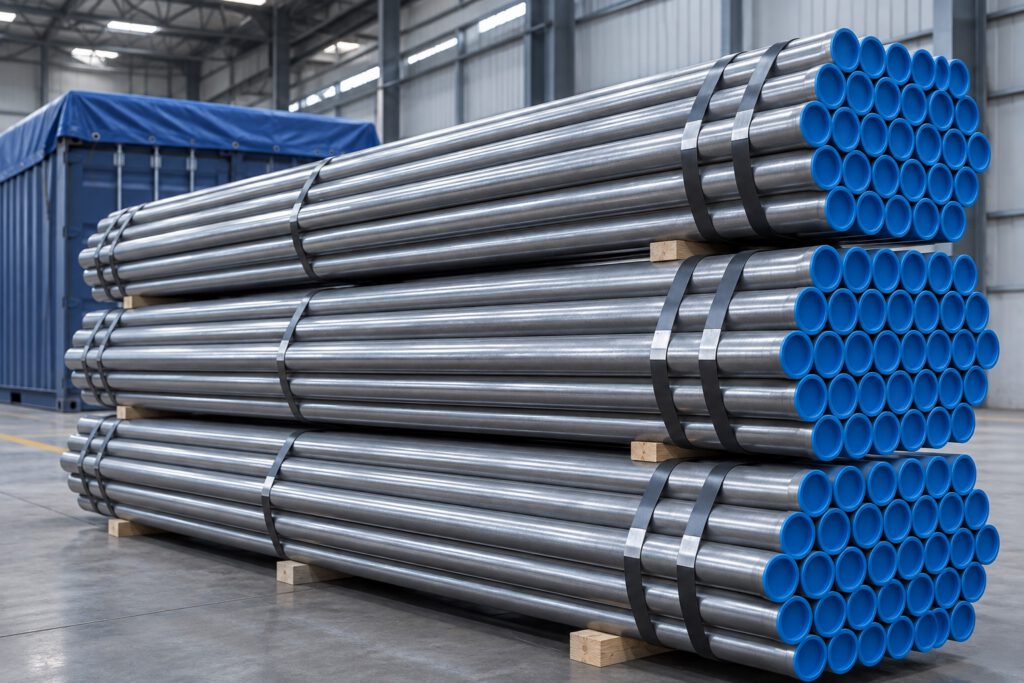
An Australian customer placed an order with Dumai Tube for mild steel welded tubes measuring 127 mm in outside diameter, 2.0 mm in wall thickness and 5,800 mm in length.
Market: Australia
Industry: Industrial Tube Supply and Manufacturing
Product: Mild Steel Welded Tubes
Specification: OD 127 mm × WT 2.0 mm × Length 5,800 mm
Project Focus: Product Protection, Transport Damage, Quality Recovery and After-Sales Responsibility
Customer Requirements and Project Background
An Australian customer placed an order with Dumai Tube for mild steel welded tubes measuring 127 mm in outside diameter, 2.0 mm in wall thickness and 5,800 mm in length.
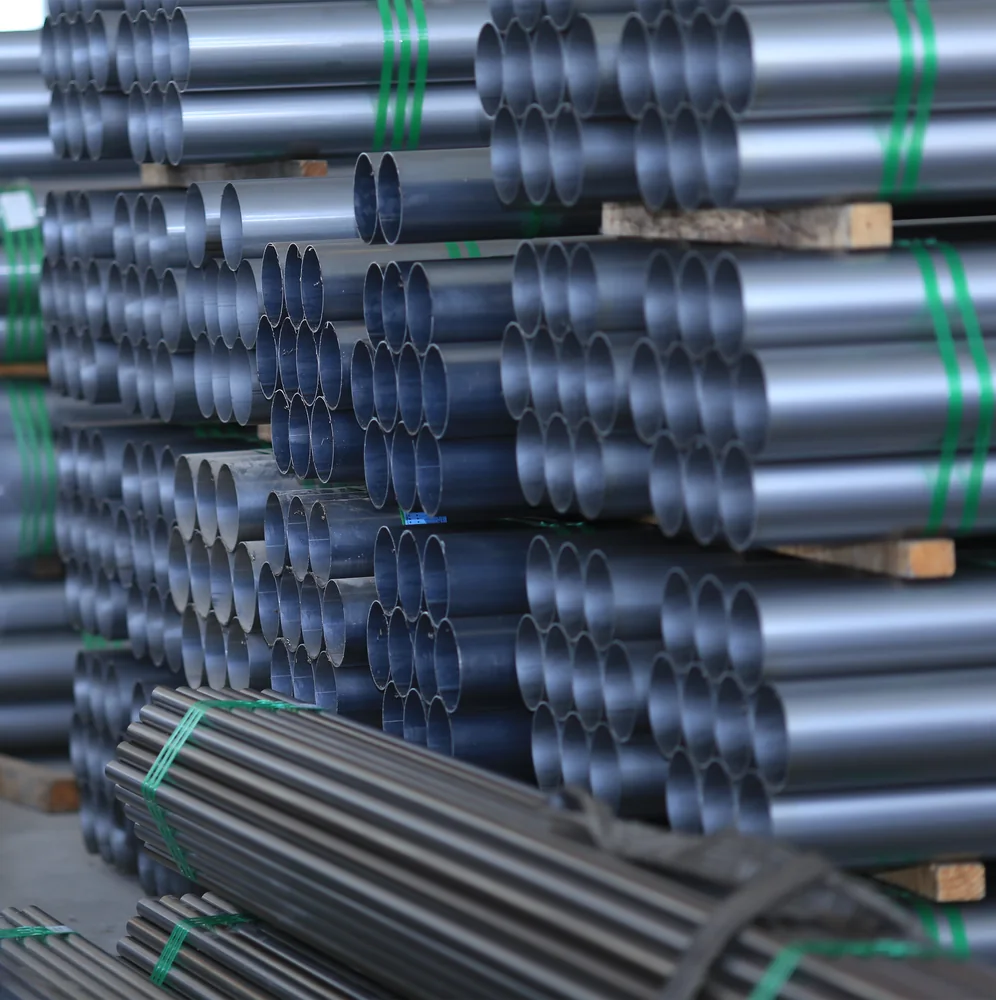
The customer required tubes suitable for further processing and industrial manufacturing. In addition to manufacturing the tubes according to the agreed dimensions, Dumai Tube needed to consider how the products would be protected during international transportation.
Unlike stainless steel, uncoated mild steel is particularly vulnerable to surface corrosion when exposed to moisture. This makes surface protection, packaging and transportation conditions important factors in preserving the condition of the finished tubes.
Considering the transportation conditions and the customer’s requirements, Dumai Tube applied a heavy protective oil coating to the tubes before shipment. The purpose was to provide additional protection against moisture and oxidation during transportation and storage.
The manufacturing process was completed, and the tubes were prepared for delivery.
The Unexpected Transportation Problem
Despite the protection measures, an unexpected problem occurred during transportation.
The shipment was handled using an open-top container, which required appropriate covering and protection from rain. Dumai Tube had specifically instructed the logistics provider to ensure that the tubes were properly covered throughout transportation.
Unfortunately, these instructions were not followed adequately.
The tubes were left exposed to rainfall, allowing water to reach the material. Despite the protective oil, portions of the shipment developed surface rust.
The incident was particularly disappointing because the tubes had already been manufactured, treated and prepared for shipment. A failure during transportation created a quality concern that could affect the customer’s ability to use the material as originally intended.
Although the immediate problem arose from the logistics provider’s handling of the shipment, Dumai Tube recognized that the customer should not be left without support.
Our Immediate Response: Transparency Before Everything Else
Rather than waiting for the shipment to reach Australia and allowing the customer to discover the corrosion independently, Dumai Tube decided to communicate the situation directly.
We informed the customer about what had happened, explained the transportation issue and discussed the potential impact on the delivered products.
More importantly, we immediately communicated our willingness to take responsibility for finding a solution.
One of the solutions we offered was to manufacture an entirely new batch of tubes at no additional product cost to the customer.
This was a significant commitment because it would have required allocating manufacturing resources, raw materials and production time to reproduce the order.
However, we considered it important to protect the customer’s interests and demonstrate that our responsibility did not end when the goods left the production line.
Finding a More Practical Solution: Rust Removal and Product Recovery
Before proceeding with complete replacement, Dumai Tube explored whether the affected tubes could be recovered.
Surface rust does not always mean that an entire steel tube is unusable. Depending on its severity, the condition of the material and the customer’s intended processing requirements, certain types of surface corrosion can be removed through appropriate cleaning and surface treatment.
We therefore arranged for the affected tubes to undergo rust-removal treatment through one of our manufacturing partners.
The objective was to restore the tubes to a condition in which they could still meet the customer’s intended needs, while avoiding unnecessary waste of manufactured material.
This approach also provided a potentially faster alternative to manufacturing an entirely new batch.
Instead of immediately disposing of the products, Dumai Tube coordinated the additional handling and cleaning process to recover as much usable material as possible.
A Second Challenge: Physical Damage During Handling
Unfortunately, the recovery process created another unexpected complication.
During transportation and handling at the cooperating factory, several tubes fell from a vehicle and became physically deformed.
This damage was different from the original corrosion problem.
While surface corrosion may sometimes be removed without affecting the functional suitability of a product, physical deformation can compromise dimensional accuracy, straightness and the ability of a tube to be used in subsequent manufacturing processes.
Dumai Tube understood that the customer had ordered tubes according to specific dimensions and should not be expected to accept defective pieces simply because the material had already undergone recovery treatment.
We therefore decided that the customer should be able to identify and exclude any unusable tubes upon receipt.
Final Commercial Resolution
When the shipment arrived in Australia, Dumai Tube communicated that the customer could inspect the tubes and identify any pieces that were no longer suitable for use.
We informed the customer that the value of those unusable tubes could be deducted directly from the payment.
In addition, Dumai Tube provided a substantial discount on the overall order to recognize the inconvenience and disruption caused by the transportation and handling incidents.
Our objective was not to argue about which external party had caused each problem. We wanted to provide the customer with a practical and commercially fair resolution.
The final arrangement combined three important elements:
- Open communication: We informed the customer of the problems rather than concealing them.
- Product recovery: We arranged additional rust-removal work to preserve usable material.
- Financial responsibility: We allowed deductions for unusable tubes and offered an additional discount on the shipment.
What This Case Represents for Dumai Tube
Manufacturing is rarely free from unexpected difficulties. Problems may occur during production, secondary processing, packaging, transportation or delivery.
We believe that the true reliability of a supplier is demonstrated not only by its ability to manufacture products correctly, but also by how it responds when an unexpected problem affects the customer.
For Dumai Tube, supplying tubes is not simply a transaction in which products are manufactured, shipped and forgotten.
We understand that customers depend on the material they purchase for their own production schedules, manufacturing operations and business commitments.
When difficulties arise, our priority is to communicate clearly, find practical solutions and work toward a fair outcome.
The Australian shipment demonstrates our approach to after-sales service: we remain involved, take customer concerns seriously and work to resolve problems rather than leaving customers to manage them alone.
At Dumai Tube, a shipment is not the end of our responsibility. It is part of a continuing business relationship.
Back to Insights